
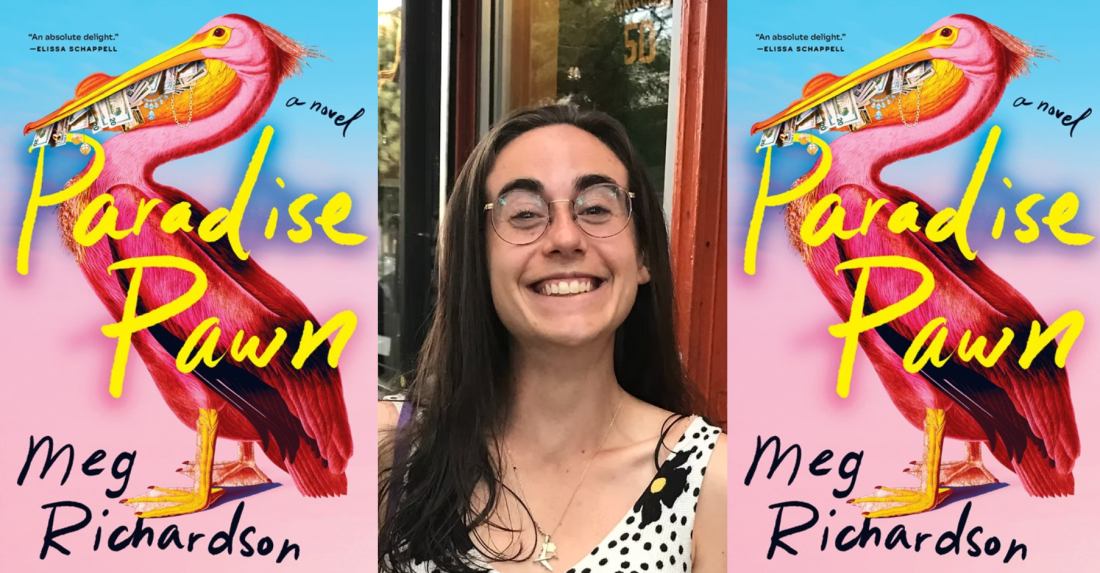
I met Meg Richardson in a workshop at Columbia, where she was writing what is now Paradise Pawn. The chapters I read then were already alive with the smart, funny voice of Richardson’s 14-year-old narrator, Jackie. What makes Richardson’s writing shine is how she balances Jackie’s childhood innocence with adolescent longings and the frustrations of becoming an adult, all while offering astute observations about inequality, labor, and class.
Paradise Pawn is also about a young female friendship. Jackie and her best friend Kayla grew up in Paradise Pawn as their dads worked behind the counter. At 14, the girls run the front desk and are impeccable at their job. When Jackie learns that Kayla will not be headed to the same private school as she will the next year, Jackie hatches a plan that she hopes will keep her friend close. As Jackie lives through the painful parts of growing up, she discovers that change cannot be stopped.
Paradise Pawn is a tender and gripping portrayal of one girl’s headlong crash into the process of growing up.
We met over video chat one afternoon in late June to talk about Jackie and the process of writing this novel.
First, I’m wondering about writing from Jackie’s point of view. In workshop, her voice was already as sharp and vulnerable as it is in the final. But adolescence is such a difficult time, and you’re also dealing with big subjects. What were some of your challenges with getting Jackie on the page?
Getting ages of kids can be tricky. I’m a cartoonist, and when I’m drawing kids or looking at someone else’s art, I can tell when something’s off, like if a kid is supposed to be in second grade but their body is too long. There were times with Jackie when I would write something and knew, “Oh, that’s not quite right,” but then there were other times when I had to trust myself.
Adolescence is a super weird time. You’re like a Mr. Potato Head of an adult eyeball and a kid arm, and you’re aware of that as a teenager, and other people are aware of that too. I also think what society asks of teenagers is weird. When I was taking my driver’s permit test, I was 14, and I was losing my teeth, which is a kid thing. While driving a car is the most adult thing. I think with kids of any gender, but with girls particularly, there’s a pressure to be responsible, motherly, but then other times adults don’t want their kids to grow up. As adults, I think it makes us sad that there are so many hard things, and we want to protect kids from them, but that’s impossible. Kids are going to figure it out on their own timelines.
Later in the book, you provide a contrast to Jackie with Beth, who I really enjoyed. She is more sheltered and has more of the hard things that Jackie notices in herself, like loneliness and friendlessness. Beth also becomes Jackie’s friend when she really needs one. What were your goals with friendship in this book, especially teenage friendship?
When you’re a teenager, it’s one of the first times when your identity doesn’t come from your family. I grew up in a very tight family, but then in high school I discovered other ways of being that were different. I guess I assumed all families were like mine. Jackie is becoming aware of the people her age, and she can be blunt about class and people’s bodies in a way that, as a writer, it was fun to have permission to do. A lot of what she says is what many people think.
Everyone’s a little insecure. When we classify someone as lower or higher class, it’s positioning ourselves in relation to other people. Adults are subtle about it, while Jackie is defining herself in relation to other people, how she looks, her class. It was fun as a writer to allow this 14-year-old girl to just say what she thinks.
I felt a lot of identification with Jackie, and she’s what makes Paradise Pawn so funny. And at the same time, there are powerful moments throughout the book that have a lot of insight and sympathy. Can you talk about your approach to writing humor?
Sometimes we laugh to keep from crying. You have a lot of power when you’re laughing at something, whether you’re being mean or making a joke. When something is bad, you can pass the experience through a sieve, find the part that’s funny and focus on it. It’s a way to get through life. I love cartoons for that reason.
There was a class at Columbia called Comedy and Calamity. I didn’t get into it because it was full, but I sat in on the first day, and the professor was talking about how humor can be like a stealth missile. You’re laughing, and then suddenly there’s an emotional leap, and because something was funny, you’re caught off guard. I was trying to do some of that in the book. If you can surprise someone who is laughing and then make them cry, it can be powerful.
Jackie lost her mother, and those were some of the moments that were the strongest. When Jackie does bring it up, you can feel how she is prickly and at an emotional loss.
I think her mom’s absence is another reason why she’s looking so hard at other people. When you’re a teenage girl, your mom is the most obvious model for your identity. I’m very close with my mom. I’m wearing the lipstick she wears right now, and Jackie doesn’t have that. So, she’s always asking, is Kayla’s mom what I’m missing? Is it Beth’s family?
I loved how money comes up in this book. Jackie is so obsessed with who has money and who doesn’t, which fits so well with the setting, the pawnshop. I wonder why Florida is such a great place to explore inequality?
Money is so hard for adults to talk about, so I think that was another reason why I wanted to use a 14-year-old who doesn’t have the same filter and politeness. It’s important to acknowledge how much inequality we see every day but are blocked from really seeing. Florida is a place where there are people of different classes living near each other. But so many places are like that.
A lot of Paradise Pawn was written in New York, where people working on Wall Street make billions of dollars and walk past homeless people. They are coexisting in the exact same space. These huge degrees of inequality are hard to talk about and wrap our heads around. I could have chosen almost any setting for the novel, and there would have been class dynamics to explore. But Florida as a paradise, like the title Paradise Pawn, is meant to be an incongruity. People come to Florida for vacation to escape their lives and act like this place is not real, but everywhere is real life for somebody.
Jackie sees the tourists come into the pawn shop and knows the people who live there and who work for the tourists.
She has empathy for a lot of different kinds of people. She knows that the people who have been working at hotels all day, coming into Paradise Pawn, want someone to serve them. She also has a lot of empathy for the people staying in the hotels because she sees that their lives aren’t more fulfilled or happy because they have money. We’re all looking for love and acceptance, and it doesn’t matter how much money you have.
I’m curious about your own pawnshop experience. What was it like?
It was much less dramatic. A lot of days were spent standing behind the counter and talking to people about their pawns or jewelry. I heard a lot of stories: it’s my grandson’s birthday, and I want to get him a bike, or my kid grew out of this wetsuit, or here’s my wedding ring. In media, pawn shops can be portrayed as seedy, but all the customers and my coworkers were good people.
Writing about work and the mundane parts of life can be difficult sometimes. I wanted to zoom in on the details like testing gold and filling out paperwork. That’s my favorite part of social media: discovering what it’s like to be a cake decorator or work at Dairy Queen. I wanted to elevate those details and celebrate how hard people work in this world every day. It’s not very exciting or dramatic or glamorous, but people show up, and that’s why our world functions.
What was the process behind writing Paradise Pawn? How did it change and develop?
I wrote it mostly during that year of workshop. And the weird thing is, it hasn’t changed that much. I’m re-reading it before I go on book tour, and it feels like reading my journal from when I was 23. There was such a gap between writing and publication because the classic thing happened. I heard “No” over and over when I was trying to sell it. It was a hard sell because the novel is about 14-year-olds, but it’s for adults. A lot of people asked if it was YA. But I didn’t want it to be YA.
You write something that comes out of your imagination, and then all these people’s voices start to say, “Here’s how to sell it.” So, I did end up mangling it a lot. There is a version of Paradise Pawn that’s YA with more puberty and more friendship. And that one didn’t sell. I put it away for eight years and started doing more cartooning. And then I saw Tin House was having like an open call for manuscripts, and I submitted the original one. I don’t know what the lesson means, but I’m grateful the novel is being published at this point in my life.
It sounds like the people in your life were big influences on this book, but did you have authors and books that you turned to?
The thing that makes me love a book is if I can’t stop reading it. One of the books that makes me feel that the most is The Guest by Emma Cline. It’s about a girl with a scheme always about to go wrong but doesn’t. I will always love the book Who Will Run the Frog Hospital by Lorrie Moore, which gave me an excuse for centering teenagers. It has a short frame about adults before you get to the teenagers, but the teenagers are the best part.
Thank you, Meg, for talking to me. Good luck on your upcoming book tour!
Fiction
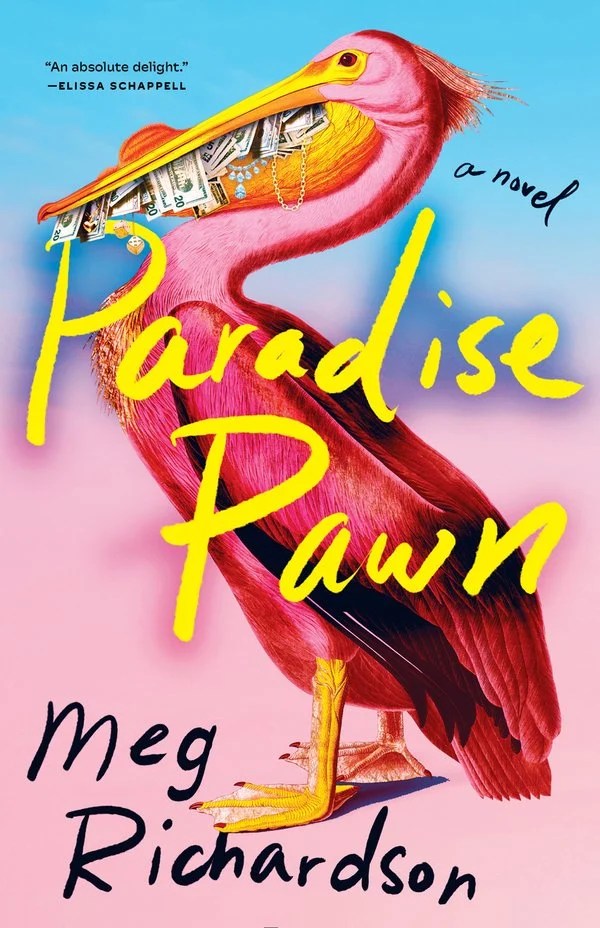
Paradise Pawn
By Meg Richardson
Tin House
Published July 14, 2026


